Capitalism has the power to absorb all criticism of itself. Howard's psychotic outbreaks are commodified up to when they directly endanger capitalism--only then, direct intervention is required, first, at the hands of Jensen and his understanding of capitalist realism (there are no nations, only companies), and then more definitively at the hands of former communists, now themselves entrenched in the market of media entertainment and the attention economy.
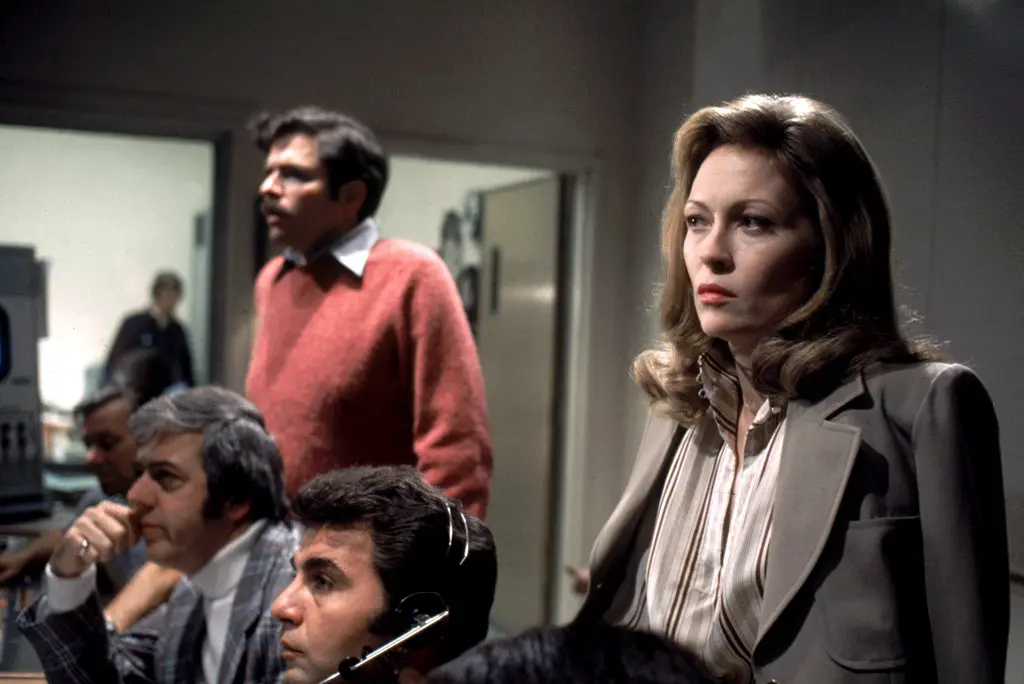
The subplot of Diana, perhaps a bit too long, is built entirely around the argument that she signifies the generation whose understanding of the world was shaped through televised media entertainment and thus wholly perpetuate and reproduce this logic now through their own work in the industry.
The arguments are, perhaps, in turn both economic and media deterministic; little agency is afforded to any of of the named characters, let alone the nameless masses watching Howard's show. Diana is incapable of living life not following an internalized imaginary TV script; Howard, after one confrontation by Jensen, becomes the spokesman of capitalist realism; Schumacher, the voice of reason, championing a return to straight news, is cast aside and can do nothing to prevent the shift from news media to affective entertainment media. Communists eager to reach a wider audience are now themselves obsessed with ratings and profits.
The pacing of Network is sometimes agonizingly slow and its satire beyond cynical, but it's messaging about media empires and capital remains as lucid as ever, and at the hands of Sydney Lumet, never becomes too inevitable, too nihilist, despite the involvement of the anti-Marxist and Zionist screenwriter Paddy Chayefsky.