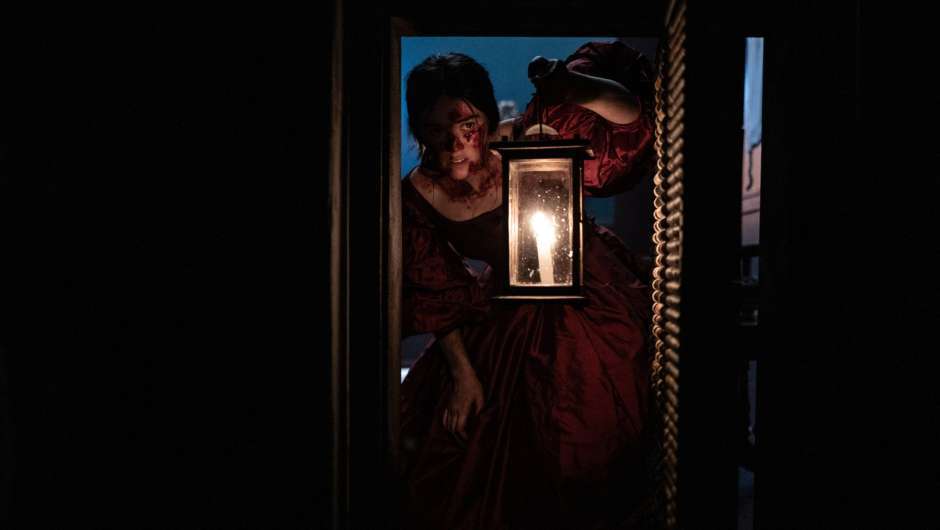
I really wanted to like this both as an anti-colonial critique and as a 'good for her cinematic universe' revenge story but unfortunately the more I think about it the more it comes apart at the seams.
My main gripe is that halfway through the story it shifts away from any structural critique that integrates the intersecting role of empire, class, indigenous ethnicity, and gender (e.g., no exploration of how Mārama's adoptive parents instilled European values of 'civility' in her, in the form of her general education, mannerisms, etc) in favor of a convoluted reveal that appears written solely for its horrific factor. Ultimately what are the motivations of Nathan, the antagonist? It makes sense to comment on sexualization, obsession, cultural appropriation, and the desire of (patriarchal) control of colonial subjects, but the way it plays out, throughout generational incest and beheadings... What was the plan here?
Moreover, what was the point of mentioning that Nathan is actually a 'pathetic' man from a poor background who hustled his way into nobility? That under British colonial rule even men like him had access to these atrocities? If that was the case, it is not further explored and seemed to further dilute any criticism of empire towards one easily hateable individual villain.
Speaking of, all white characters in the film are two-dimensional evil caricatures. Within the context of this film I have no gripes with this necessarily--scenes like Nathan's birthday party continue to play out in real life today--but having the one somewhat sympathetic character, Arthur, himself a victim of grooming, being outed as gay right before his murder to therefore categorize him as a marginalized minority himself felt a bit overkill. (For a while, I also thought Jack, given his seemingly strong understanding of Maori language and culture, was meant to be, essentially, a race traitor playing the part of court jester among British nobility, but that ultimately doesn't seem to be the case.)
Rather than through deduction, the mystery itself unfolds similarly to a walking simulator videogame through the protagonist's interaction with her environments, as a seer, realizing the horror of her situation through glimpses in the past. While this fits with the theme of "walking backwards into the future," it does not make for a very rewarding experience.
The biggest moment of suspense of disbelief for me, I guess, was towards the ending. Jack was supposed to knock Mārama out and bring her to Nathan--instead she barges in and is given all opportunity to grab one of many readily available Maori weapons to strike Nathan down. Ok.
Good performances from Ariāna Osborne though.