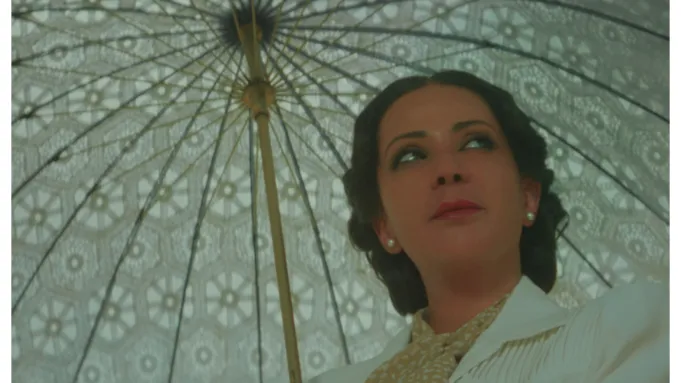
Making a biopic of a pan-Arabic legend, whose rich career spanned over 70 years, while navigating both the personal and the rapid political and socioeconomic developments of Egypt, is no easy feat, and the end result is good; it is touching, entertaining, captivating. (Pan-)nationalist undertones, too, are not unreasonable given Umm Kulthum's actual societal standing and her material support for the Palestinian people and the war efforts.
I am not entirely a fan of the rapid shots, aesthetic choices, and soundtrack, though; why does the biopic of an artist whose songs last up to an hour simultaneously feel like a frantic French nouvelle vague film and a Baz Luhrmann film? Why not give her performances space to breathe, without unnecessary reorchestrations?
I liked Mona Zaki's performance, but I can imagine that the portrayal of Umm Kulthum as deeply vulnerable in her later life is a controversial perspective. In the first half, she is portrayed as a strong, independent and even feminist woman (note the addition of a pamphlet on the suffragettes at some point)--perhaps, the film seems to insinuate, due to having disguised herself as a man well into her 20s--while in her latter life, the film goes out of its way to portray her as someone lonely, afraid of her looks and age, someone that needs a man to protect her.
Moreover, and this is a minor note, because it wants to maintain a consistent narrative, despite covering 70 years, the film also heavily focuses on Rami Ahmed and Mohammed El-Qasabgi as Umm Kulthum's lifelong collaborators, at the detriment of all the other long-term collaborators, including those behind her legendary Alf Leila wa Leila or Enta Omri. Composer and collaborator Mohammed Abdel Wahab is mentioned only as the man running against her for running the syndicate, positioning him as someone that does not want to see a woman in a position of power.